
Refusing the Sword
Christian resistance to state-sponsored violence

The fatal shootings of Alex Pretti and Renee Good in controversial encounters with ICE and Border Patrol agents in Minneapolis has shifted the question of how Christians should respond to state-sponsored violence from an abstract theological query to a moral emergency that presses on our faith and conscience.
Responding to state‑sponsored violence has never been a simple matter for Christians. Scripture places us in a creative tension: on the one hand, we are told to respect governing authorities; on the other, we are summoned to obey God, love our neighbors, and pursue justice—even when those authorities become agents of harm.
See: Rom. 13:1–7; 1 Pet. 2:13–17; Acts 5:29; Mic. 6:8; Luke 10:33–37
This tension is not a flaw in Christian ethics. It is a feature. It forces discernment rather than reflex, faithfulness rather than slogans. Across history, Christians have navigated this terrain through a handful of recurring moral frameworks. None are cost‑free. All demand courage.
Here are the most common of these moral frameworks. You won’t find simple easy answers here, but hopefully, you’ll find a moral map to the ways a Christian can respond to state-sponsored violence.
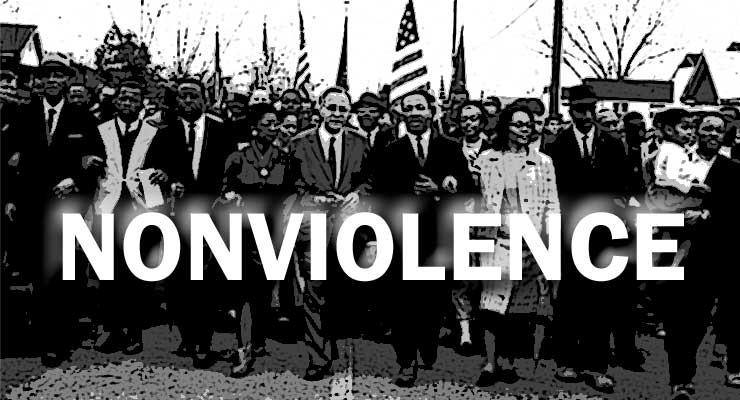
From the earliest centuries of the church to modern “peace church” traditions, many Christians have concluded that Jesus’ teaching leaves no room for violence—whether personal or political.
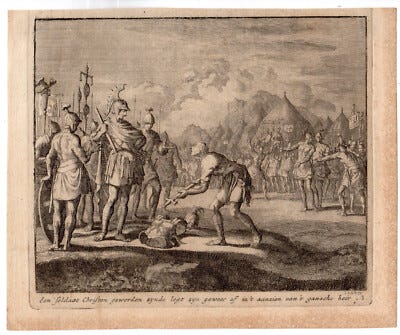
This stance was not lightly taken by the early Christians who lived under Roman power vastly more oppressive than most of us will ever experience. Yet many chose this costly path of refusing violence—declining military service, resisting emperor worship, and accepting martyrdom rather than mirroring imperial violence. Their witness became a light in the empire’s darkness, showing that the triumph of Christ’s way is found in non-retaliatory love.
See Acts 4–7; 16; 19 for the church’s repeated refusal to meet imperial violence with violence.
Jesus’ commands to turn the other cheek and love your enemies were not treated as spiritual ideals only for private life but also as spiritual ideals for public, political acts. Jesus’ refusal to resist arrest, and his rebuke of Peter’s sword, are read not as tragic necessities but as deliberate revelation: this is what God looks like when confronted by state violence.
For Christians committed to non‑violence, the cross is not merely redemptive—it is instructional.
The goal of non-violence is not passivity. It is disruption. Non‑violence seeks to break the spiral of violence by absorbing it, exposing it, and refusing to mirror it. Suffering, in this view, becomes a form of witness. Martyrdom is not sought, but neither is it avoided if faithfulness requires it.
This framework insists that the church’s power lies not in coercion, but in costly love.
Paul’s instruction to submit to governing authorities has often been weaponized to silence dissent. But within the Christian tradition, submission has almost always been understood as conditional, not absolute.
There are times when earthly authorities demand actions that are in direct opposition to God’s commands or prohibit what God requires. In these situations, Scripture offers a decisive directive: our ultimate loyalty is to God. When faced with such a conflict, Christians are called to obey God rather than human authorities, even if it means facing consequences for civil disobedience. This conviction forms the foundation for Christian resistance to unjust laws and underscores the principle that faithfulness to God takes precedence over compliance with the state.
The Bible is surprisingly rich with examples of faithful disobedience:
· Midwives who defied Pharaoh to save innocent lives (Exod. 1:15–21).
· A palace administrator who hid persecuted prophets from a violent regime(1 Kgs. 18:3–4)
· An exiled servant of God who continued to pray despite a royal ban (Dan. 6:6–10).
In each case, resistance is real—but restrained. The dominant Christian instinct has been non‑violent civil disobedience: refusing unjust laws, engaging in protest, petition, and legal challenge, and accepting the consequences without retaliation.
Martin Luther King Jr. stood squarely in this tradition of principled non-violent civil resistance. Rooted in the Sermon on the Mount and the prophetic imagination of Scripture, King taught that unjust laws degrade human dignity and must be resisted—with bodies willing to bear the cost, not fists, so that truth might break open hardened hearts and unjust structures. His non-violent strategy was not passive waiting but active confrontation with love’s resolve.
This form of resistance takes the law seriously enough to break it openly—and love seriously enough to suffer for doing so.
I hesitate to include this third moral framework not only because it is less common—but because I do not see this as a legitimate framework for resisting state-sponsored violence—even when confronting extreme state brutality.
This framework permits the use of force in resistance to state-sponsored violence under these severe moral constraints: in a just cause, with right intention, as a last resort, for the protection of the innocent.
Those who argue this position often do so from the conviction that love of neighbor sometimes demands protection, not only protest. If all peaceful means have been exhausted, and if vulnerable lives remain under immediate threat, non- violent restraint alone may no longer be sufficient.
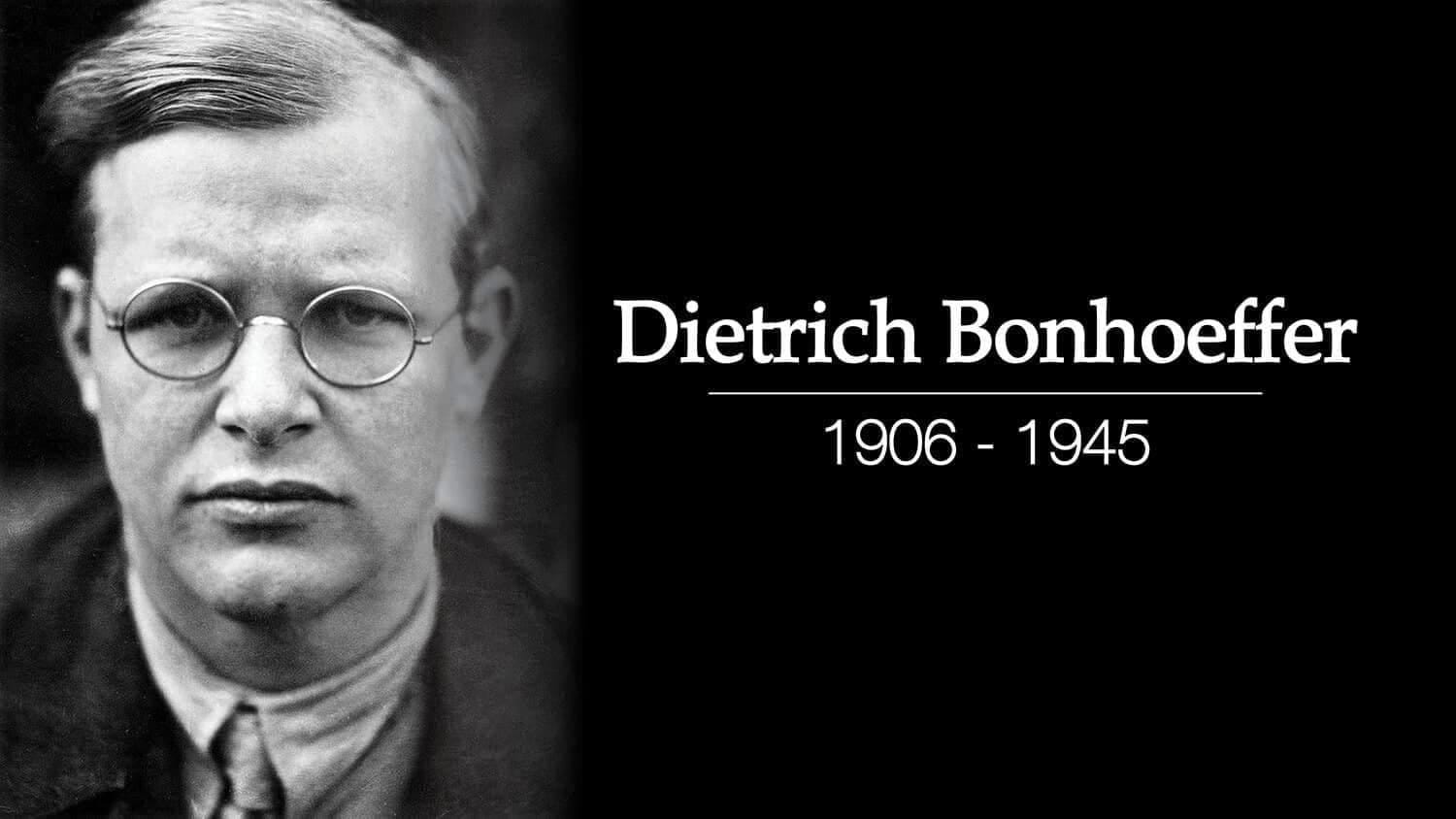
Dietrich Bonhoeffer, a German pastor, author and theologian living under Nazi terror concluded that responsible action in a fallen world sometimes requires decisions that leave no good options—not because violence is righteous, but because evil threatens innocent lives. His life, martyrdom and reflections remind us that Christian ethics must resist simplistic categories when confronted with catastrophic state power and that guilt for doing what we must can itself be a faithful posture.
Even here, the emphasis is on the tragedy of violence, not its triumph. Any use of force is understood as a moral failure of the world, not a victory for the kingdom of God.
Survival: Hiding, fleeing, or adapting in order to preserve the faith community and protect life.
Association: Dialogue, bridge‑building, and acts of service aimed at softening hearts and restraining violence from within.
Confrontation: Public witness through non‑violent protest, civil disobedience, and legal challenge, seeking structural change.
These modes are not mutually exclusive. Often, they appear entwined together, shifting as the circumstances of state-sponsored violence evolve.

Despite their differences, these approaches share a striking common thread: Christian resistance must be rooted in love.
Not sentimental love. Not patriotic love. Cruciform love.
The aim is not revenge, nor even mere reform, but restoration—the healing of relationships, the exposure of lies, the protection of the vulnerable, and the refusal to let violence have the final word.
The question is not simply What should Christians do when the state becomes violent?
It is Who are we becoming as we respond?
In moments like these, we who follow Jesus are not called first to certainty, but to faithfulness. We lament lives lost to the machinery of power, refusing to anesthetize ourselves with abstractions or excuses. We hope—not in the inevitability of progress, but in the God who raises the crucified and exposes the lies of every empire. And we engage constructively: forming communities of truth, protecting the vulnerable, telling the truth about violence even when it is uncomfortable, and resisting in ways that do not deform us into the image of what we oppose. The question before the church is not whether history will judge this moment, but whether our response will bear the marks of the One who was executed by the state and yet remains Lord. Faithfulness, here and now, will look less like certainty and more like courage rooted in love, practiced in public, and shaped by the cross.
Faithfulness, in the end, is measured not by how forcefully we resist—but by how closely our resistance resembles the way of Christ.