
Between Cross and Crown
Why Lent Matters in Anxious Times


We are not living in calm days.
The air feels charged — politically, culturally, spiritually. Every week presents another reason to fear collapse, seize control, defend our tribe, or baptize our outrage. Even many churches feel caught between activism and exhaustion.
And then Lent arrives.
Not loud.
Not triumphant.
Not reactive.
Just forty days of quiet insistence: Remember who you are.
In the fourth century, after Constantine the Great legalized Christianity in the Roman Empire, the Church faced a new reality. Adult converts flooded in. Baptism was no longer a hidden act of defiance but a public turning toward a new allegiance..
Baptism is not symbolic self-expression. It is burial and resurrection:
“We were buried therefore with him by baptism into death… that we too might walk in newness of life” (Romans 6:4).
Lent became the Church’s way of saying: this is a serious decision.
Catechumens fasted. They prayed. They were scrutinized. They renounced old loyalties before entering the waters of Holy Baptism at Easter.
Lent was not about feeling religious.
It was about dying and rising.
Over time, the season of Lent shifted. Instead of preparing those seeking baptism, the whole Church began to prepare for renewal. Lent became corporate repentance — a time for the baptized to remember their baptism.
In other words: Lent is not about becoming impressive Christians.
It is about becoming honest ones.
At its heart, Lent is about identity.
Not partisan identity.
Not cultural identity.
Not grievance-based identity.
Baptismal identity.
You have died with Christ.
You have risen with Christ.
Your life is hidden with Christ in God.
Baptismal identity is profoundly stabilizing in unstable times. It means we do not have to seize the crown now. We do not have to secure the kingdom by force, outrage, or manipulation.
We live between Cross and Crown.
And Lent trains us to remain there.
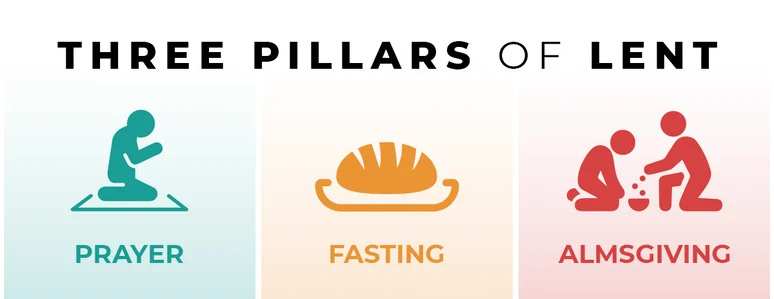
In the sixth chapter of the Gospel of Matthew, Jesus gives three simple practices:
prayer, fasting, and almsgiving.
And then he gives this warning:
“Do not be like the hypocrites.”
Do it in secret.
Because religious performance is just another form of control.
Do it in secret,
Because anxiety craves visibility. Fear wants applause. Power wants to be seen.
Do it in secret
Prayer re-centers us on the Father “who sees in secret”. It teaches us to say, “Your kingdom come,” before we demand our preferred outcomes.
Prayer loosens the illusion that everything depends on us.
Fasting exposes our attachments. When Jesus fasted in the wilderness, he refused to turn stones into bread, with these words: “Man shall not live by bread alone.” Lent confronts our appetites.
Fasting exposes how enslaved we are to appetite, not just for food, but for control.
Almsgiving loosens Mammon’s grip. It teaches us that our money belongs to God. He has provided it so we can be generous to those in need.
Almsgiving breaks the gravitational pull of self-protection.
None of this earns grace. All of it makes space for grace.
Particularly, in anxious times, these practices become quiet resistance.
They say: God is enough.
They resist:
The need to react immediately
The seduction of outrage
The temptation to dominate
Lent is resistance training in patient obedience.
“My grace is sufficient for you, for my power is made perfect in weakness” (2 Corinthians 12:9).
Modern culture tells us freedom means more strength, more choice, more voice, more power. MORE
Lent tells us freedom comes through limitation.
When we limit ourselves voluntarily — a smaller diet, a quieter schedule, fewer words — we discover how much of our “freedom” was really compulsion. We begin to see the interior vices that drive us: fear, envy, resentment, pride.
And strangely, exposing our vices does not crush us. It humbles us.
And humility is the soil where grace grows.
We begin to realize that our weakness is not an obstacle to God’s work — it is the doorway.

We live in a performative age. Everything is curated. Everything is announced. Even repentance can become performance. We inhabit a culture that monetizes visibility.
Lent refuses performance.
Jesus’ insistence on secrecy in Matthew 6 is not about privacy for its own sake. It is about purification of motive. God is not a means to our self-justification.
The disciplines are meant to lead us away from performative religion toward encounter with God as the true Other.
This is slow work. Quiet work. Work that cannot be livestreamed.
But it is the kind of work that forms durable Christians.
Lent slows us down enough to ask hard questions:
What forms my imagination more — cable news or Scripture?
What shapes my reactions more — social media or the Psalms?
What drives my urgency more — fear or hope?
To a Christian already exhausted by life in our high octane world, the added spiritual pressure of Lent can sound unbearable.
But true Lenten discipline does not exhaust — it simplifies.
It strips away noise.
It reduces clutter.
It creates space.
And that space allows the Church to do what she was always meant to do: support those seeking baptism, restore those seeking reconciliation, and rediscover what it means to belong to one another in Christ.
Lenten discipline is not about guilt. It is about clearing space for joy, so the resurrection joy of Easter can be realized, not in a sentimental Hallmark card way, but with a heart tested by repentance and surrendered to God.
Lent reminds us of the pain of the cross, the joy of the resurrection, and the hope of the crown.
The temptation in violent or volatile times is to grab the crown prematurely.
To secure influence.
To defend territory.
To fight fire with fire.
But the Church’s pattern is different. It is
Cross before Crown.
Death before Resurrection.
Hiddenness before Glory.
Lent reminds us that disciplined faithfulness is not passivity. It is formation.
Lent forms people who:
Do not panic when history trembles
Do not grasp for dominance
Do not confuse political victory with the kingdom of God
It forms people who can wait. And waiting, in Scripture, is not weakness. It is trust stretched across time.
“those who wait for the Lord shall renew their strength” (Isaiah 40:31).
So when Lent comes in the middle of anxious headlines, receive it as mercy.
It is the Church’s refusal to let us become frantic. It is the Spirit’s quiet training in cruciform faithfulness.
Lent is the training ground for those who would live faithfully between Cross and Crown.
So let me ask you: where is anxiety gripping you right now? Where are you tempted to grasp for the crown instead of trusting the Cross? Ash Wednesday began Lent one week ago, I’d love to hear how you are choosing to lean into Lent this year — what you’re fasting from, what you’re praying toward, what God may be exposing or simplifying in you. Share in the comments.
We do not walk these forty days alone. We walk them together, learning again how to wait for resurrection.